
the beginning of grace: Learning to Extend It to Ourselves
There is a particular kind of exhaustion that comes from holding yourself to an impossible standard. You know the one. It whispers to you in the early morning. You haven’t opened your eyes yet and already you’re cataloguing the ways you’re not enough. Not present enough. Not patient enough. Not productive enough. Not kind enough to yourself.
We do this, don’t we. We pour grace over everyone around us like it’s the most natural thing in the world, yet when it comes to ourselves, we tighten our grip. We hold ourselves accountable with a severity we would never dream of extending to someone we love.
I wonder if you’ve noticed this in yourself. That moment when a friend tells you she’s struggling and without hesitation you offer her words of comfort and understanding. Yet, when you stumble, when you snap or forget an important task or simply have a day where nothing goes right, you turn that same attention inward as criticism. The kind that lodges itself in your chest and stays there.
This is where the work begins. Not with grand declarations or dramatic transformations, but with the simple act of turning toward yourself with something that looks a lot like tenderness.
What Grace Actually Is
We talk about grace a lot in faith spaces. We sing about it, we pray about it, we find it in Scripture. Sometimes those words become familiar enough that we forget to feel them. Grace is not perfection. It is not earning your way into acceptability. It is not a reward for getting it all right.
Grace is the space between who you are and who you think you should be.
It is the breath you take when you realise you’re human remember that we as humans are fragile and imperfect and still, somehow are loved.
Grace is the permission slip you never knew you needed. It says:
You can rest now. You can be incomplete and still be whole. You can fail and not be a failure.
When we extend grace to ourselves, we’re not letting ourselves off the hook. We’re not excusing cruelty or carelessness or the parts of ourselves that genuinely need to grow. What we’re doing is showing up for ourselves with the same compassion we show when someone we care about is struggling. We’re acknowledging that being alive is hard. That trying is hard. That sometimes you do your best and it’s still not perfect, and that has to be enough because it’s all you had to give that day.
The truth that shifts everything is this:
You cannot shame yourself into being better. You can only love yourself into becoming who you’re meant to be.
The Scripture We Need
Come to me, all you who are weary and burdened, and I will give you rest. Take my yoke upon you and learn from me, for I am gentle and humble in heart, and you will find rest for your souls.
matthew 11: 28-29
“Come to me, all you who are weary and burdened, and I will give you rest. Take my yoke upon you and learn from me, for I am gentle and humble in heart, and you will find rest for your souls.” Matthew 11: 28-29
A Reflection for Right Now
You’ve carried so much. The expectations that live in your head, the mistakes you can’t quite forgive, the ways you’ve fallen short of your own ideals. You’ve held yourself to account with an intensity that would crack most people. Maybe it’s time to set some of that down.
Extending grace to yourself doesn’t mean you stop caring about growth or change. It means you stop hitting yourself with the hammer of perfectionism every time you stumble. It means you begin to see your flaws not as disqualifying evidence of your worthlessness, but as places where you’re still becoming.
This is the beginning of grace. Just this awareness. Just this small turning toward yourself with gentleness instead of judgment.
Journaling Reflection: Opening the Door to Self-Grace
Take some time with these prompts. There’s no rush. Journal slowly. Sit with what comes up, even if it feels uncomfortable.
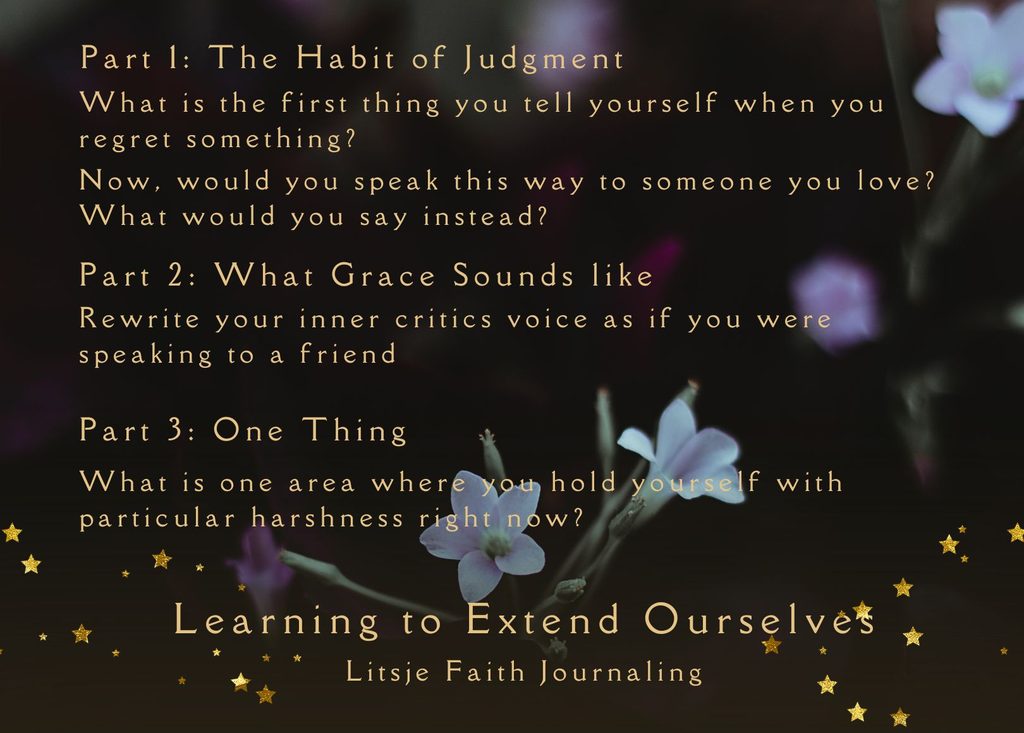
Part One: The Habit of Judgment
When you think about something you’ve done recently that you regret or wish you could redo, what’s the first thing you tell yourself?
Write out that internal voice. Don’t soften it. Don’t make it palatable. What does your inner critic actually say?
What words does it use?
Now, read those words back to yourself. Would you ever speak to someone you love this way?
If a friend told you she’d done the same thing, what would you say to her instead?
Part Two: What Grace Sounds Like
Now rewrite that critical inner voice as if you were speaking to a dear friend. What would you tell her?
How would you acknowledge her struggle while also reassuring her of her worth?
Write out what grace sounds like when it comes from you, for someone else. This is what you’re learning to speak to yourself.
Part Three: One Thing
What is one area of your life right now where you’re holding yourself with particular judgment or harshness?
It might be something you said, a decision you made, a way you showed up, a goal you haven’t reached. Name it.
Then ask yourself: what would it feel like to extend the same grace to myself that I’d extend to someone I care about? What would shift?
Your Action: The Grace Ritual
This week, each time you catch yourself in that familiar spiral of self-criticism, pause. Take one conscious breath. Then place your hand on your heart and speak one sentence of grace to yourself. It can be simple.
“I’m doing my best.” “I’m allowed to be human.” “I’m learning.” “This is hard and I’m still here.”
Notice what it feels like to speak kindness to yourself instead of cruelty. This small practice is not indulgent. It’s the beginning of rewiring how you relate to yourself.
A Closing Prayer
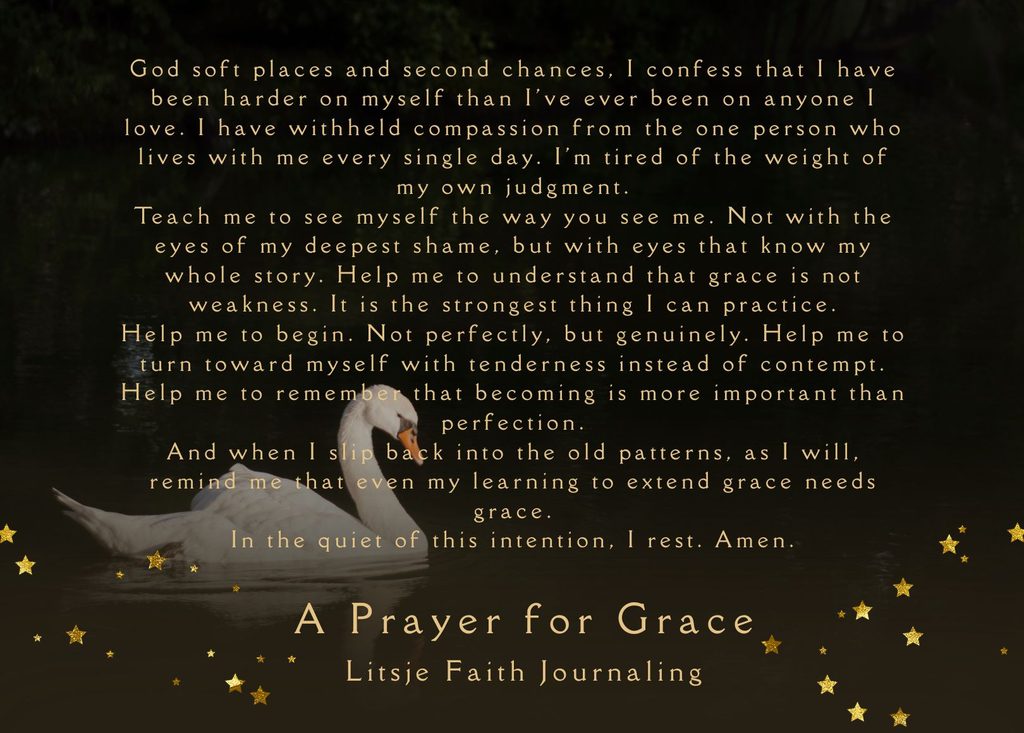
God soft places and second chances, I confess that I have been harder on myself than I’ve ever been on anyone I love. I have withheld compassion from the one person who lives with me every single day. I’m tired of the weight of my own judgment.
Teach me to see myself the way you see me. Not with the eyes of my deepest shame, but with eyes that know my whole story. Help me to understand that grace is not weakness. It is the strongest thing I can practice.
Help me to begin. Not perfectly, but genuinely. Help me to turn toward myself with tenderness instead of contempt. Help me to remember that becoming is more important than perfection.
And when I slip back into the old patterns, as I will, remind me that even my learning to extend grace needs grace.
In the quiet of this intention, I rest. Amen.
Grace is not a destination you arrive at. It’s a practice you return to, again and again, with patience. This is the first post in a series exploring what it means to extend grace to ourselves. Come back as we dig deeper into the ways we deny ourselves compassion and how we can unlearn that habit, one moment at a time.
Yours in Faith – Debbera